


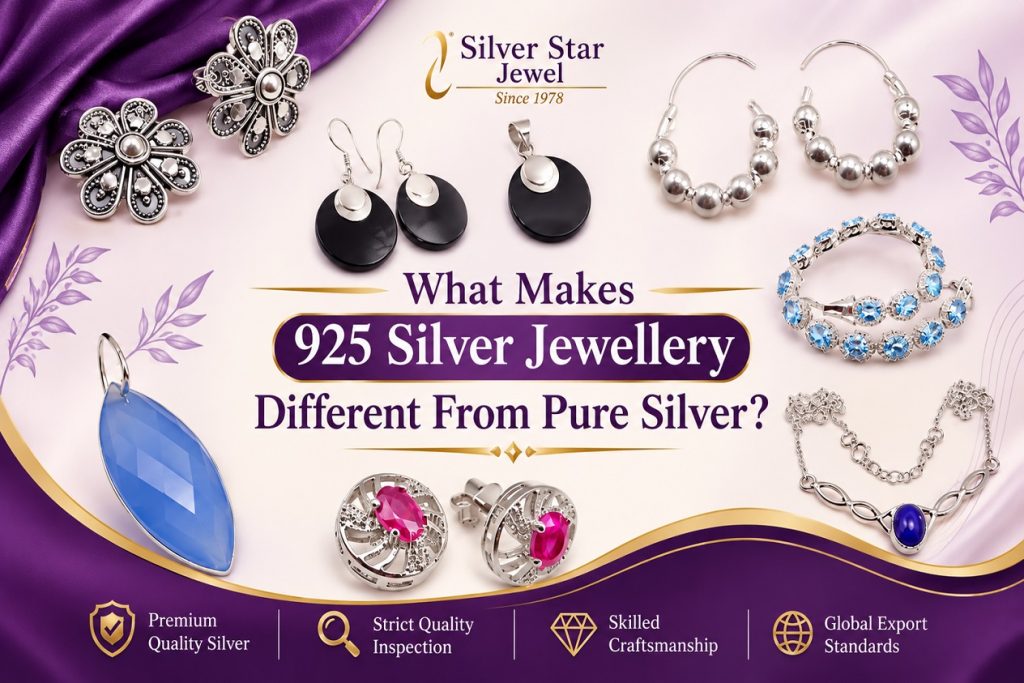
Silver has been valued for centuries in jewellery because of its bright white colour, malleability, and resistance to corrosion under normal conditions. Metallurgists and materials scientists distinguish carefully between pure silver and the alloy known as 925 silver. Pure silver contains 99.9 percent silver and is often marked 999. It is extremely soft. Everyday contact, friction, and even light pressure can deform or scratch it. In contrast, the alloy standard used for most wearable pieces balances purity with practical strength. Understanding this difference helps explain why one form dominates modern jewellery production while the other remains limited to specialised uses.
Composition of 925 Silver Jewellery and Its Practical Strength
925 Silver Jewellery consists of 92.5 percent pure silver combined with 7.5 percent other metals, most commonly copper. This precise ratio is defined by international hallmarking standards and has been refined through centuries of practical metallurgy. The added copper atoms sit within the silver crystal structure and hinder the movement of dislocations that cause pure silver to bend so easily. Academic studies in materials science confirm that this small alloying addition raises hardness and tensile strength without destroying the desirable white colour or high reflectivity of silver. Pure silver lacks these reinforcing atoms, so it remains too soft for rings, earrings, or chains that must survive daily wear. The alloy therefore offers a reliable compromise between aesthetic quality and mechanical durability.
Laboratory tests show that the hardness of the 925 alloy is significantly higher than that of pure silver. This difference reduces the risk of deformation when a piece is dropped or subjected to normal handling. At the same time, the high silver content preserves the metal’s natural resistance to most chemical attack and its ability to take a high polish. These properties make the alloy suitable for long-term use, while pure silver is generally reserved for decorative objects that remain stationary.
Role of Sterling Silver Earrings Wholesale in Consistent Supply
Sterling Silver Earrings Wholesale channels allow manufacturers and retailers to obtain large quantities of finished or semi-finished pieces that meet the 925 standard. Because the alloy is harder than pure silver, it can be stamped, cast, and finished with greater consistency across production runs. Academic analyses of jewellery manufacturing note that uniform alloy composition reduces rejection rates during quality checks. Bulk supply of earrings therefore benefits from the mechanical reliability of the 925 mix. Pure silver would require more careful handling at every stage and would show higher rates of surface damage, making large-scale production less efficient.
The wholesale pathway also supports standardised hallmarking. Each batch can be tested for silver content and marked accordingly. This verification process gives buyers confidence that the material will perform as expected over time. In contrast, pure silver pieces, although higher in silver content, demand different care protocols and are less commonly offered in wholesale volumes for wearable jewellery.
Applications of Wholesale Silver Pendants and Alloy Benefits
Wholesale Silver Pendants illustrate another practical advantage of the 925 alloy. Pendants often feature detailed surface textures, openwork designs, or gemstone settings. The added hardness of the alloy allows these fine details to hold their shape during casting, polishing, and subsequent wear. Materials research shows that pure silver tends to flow or compress under the pressures used in commercial finishing processes. The alloy resists this tendency, enabling clearer definition of engraved or textured surfaces. As a result, pendants produced to the 925 standard maintain their intended appearance longer under normal conditions of use.
Bulk distribution of such pendants further relies on the alloy’s predictable behaviour during soldering and assembly. Joints form more reliably, and the finished pieces withstand the stresses of shipping and display. Pure silver would introduce greater variability and higher risk of distortion at these stages.
Durability and Everyday Performance Differences
The mechanical superiority of the 925 alloy becomes most evident in daily wear. Rings and bracelets experience repeated flexing and abrasion. Pure silver would gradually lose its original shape or develop deep scratches. The alloy resists these changes for a longer period. Surface science studies indicate that the copper addition also influences the rate and appearance of tarnish. Both pure silver and the alloy react with sulphur compounds in the air, yet the alloy’s surface oxide layer often develops more slowly or appears less uniform, allowing polishing to restore brightness with less effort in many cases.
Thermal conductivity and electrical properties remain close to those of pure silver because the silver content is still dominant. This continuity preserves the metal’s familiar cool touch and bright lustre. The difference lies mainly in structural integrity rather than in optical or thermal behaviour.
Care Requirements and Longevity Considerations
Both pure silver and the 925 alloy require protection from harsh chemicals, prolonged exposure to moisture, and abrasive contact. Academic guidance on metal conservation emphasises storage in low-sulphur environments and gentle cleaning methods. The alloy’s greater hardness simply means that minor surface marks accumulate more slowly, extending the interval between professional polishing sessions. Pure silver pieces, when used in jewellery, often need more frequent attention to retain their original form.
Hallmarking systems provide clear identification. The mark 925 or the word “sterling” indicates the alloy standard. Pure silver is usually marked 999 or “fine silver.” These marks allow buyers and conservators to select appropriate care routines and to understand expected performance over decades of use.
Economic and Manufacturing Implications
From a production standpoint, the 925 standard supports efficient large-scale manufacturing. The alloy can be melted, cast, and worked with established industrial equipment. Pure silver’s softness increases the likelihood of defects during high-speed processes. Cost calculations therefore favour the alloy for most commercial jewellery. Although pure silver commands a higher price per unit of silver content, the additional processing and handling costs often offset any material premium when the metal is formed into wearable objects.
Recycling and refining practices also treat the two materials differently. The alloy requires separation of the copper component if pure silver is the desired end product. These metallurgical realities reinforce the practical separation of uses: pure silver for bullion, specialised decorative work, or scientific applications; the 925 alloy for durable personal adornment.
Conclusion
The distinction between 925 silver and pure silver rests on a deliberate balance of composition and performance. Pure silver offers maximum purity and softness, suited to objects that experience minimal mechanical stress. The 925 alloy introduces a controlled amount of copper that raises hardness and durability while retaining most of silver’s visual and chemical qualities. This combination explains its widespread use in earrings, pendants, and other jewellery meant for regular wear. Standardised hallmarking, consistent manufacturing behaviour, and improved resistance to everyday damage all follow from the alloy formulation. Understanding these material differences allows informed evaluation of silver jewellery based on intended use rather than on purity percentage alone.
Frequently Asked Questions (FAQs)
Que. Why is pure silver rarely used for everyday jewellery?
Ans. Pure silver is too soft for rings, earrings, or chains that encounter regular friction and pressure. It deforms and scratches easily, whereas the 925 alloy provides the hardness needed for everyday wear.
Que. Does the copper in 925 silver affect the colour of the metal?
Ans. The copper content is low enough that the overall colour remains close to that of pure silver. High polishing restores a bright white appearance that is difficult to distinguish from fine silver under normal lighting.
Que. How can a buyer confirm that a piece is 925 silver rather than pure silver?
Ans. Look for the official hallmark 925 or the word sterling stamped on the piece. Pure silver is typically marked 999 or fine silver. Independent assay testing can also verify the exact composition.
Que. Does 925 silver tarnish faster than pure silver?
Ans. Both react with sulphur compounds in the air. The alloy may develop a slightly different tarnish pattern, yet regular gentle cleaning restores brightness in either case. Proper storage slows the process for both materials.
Que. Can 925 silver jewellery be recycled into pure silver?
Ans. Yes. Refining processes separate the copper and other alloying elements, recovering high-purity silver. The recovered metal can then be used for bullion or further alloying as required.