


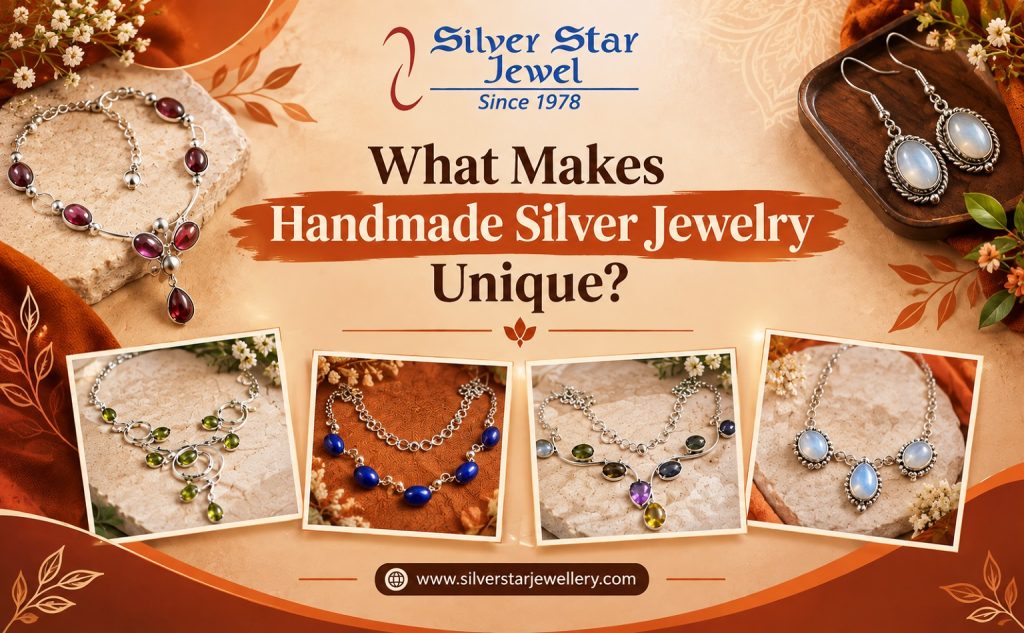
I once watched a jeweler spend almost forty minutes adjusting a single prong on a ring, just so a garnet would sit at the right angle. Nobody was paying him by the minute for that. He just wanted it right. That’s the kind of thing you don’t get from a machine, and it’s a big part of why handmade silver jewelry still holds its own against mass production, decades after factories figured out how to churn out “perfect” pieces by the thousand. Below, I’ll get into why that difference matters, how gemstones play into it, and why buyers – and retailers – keep gravitating back to it.
Story Behind Handmade Silver Jewelry
Handmade jewelry starts with someone, not a machine. A block or wire of raw silver, some heat, a hammer, a lot of filing. The process eats up hours. Sometimes days, for one piece. And because a human is doing the work instead of a robotic arm repeating the same motion a thousand times an hour, you end up with tiny variations – a slightly uneven curve, a texture that’s rougher in one spot than another. People sometimes assume that’s a flaw. It isn’t. It’s basically a signature, even if the artisan never signs their name.
Craftsmanship That Machines Cannot Replicate
Try asking a goldsmith how long it took them to get decent at filigree work. You’ll usually get a pause before the answer, then something like “years, honestly.” Hand-forging, oxidizing metal for contrast, setting a stone without a machine press – none of that comes quickly. Look closely at where a stone meets its setting on a handmade piece, or where two bits of silver have been soldered together. There’s a texture to it that factory output just doesn’t have. Machine pieces are flawless in a flat sort of way. Handmade ones are flawless in a way that still looks alive.
Role of Gemstones in Elevating Silver Designs
On its own, silver already looks good. Add a decent gemstone and the whole thing shifts. Turquoise warms it up. Garnet gives it weight. Moonstone does that quiet shimmer thing that never quite translates in photos but looks incredible on someone’s wrist in person. Artisans aren’t just grabbing whatever stone is sitting closest, either – color balance matters, so does how a stone will look against different skin tones, and sometimes what a stone is supposed to mean culturally. It’s a real decision, not an afterthought bolted onto the design at the end.
Wholesale Sterling Silver Gemstone Jewelry
For anyone running a store, physical or online, sourcing through a supplier that focuses on Wholesale Sterling Silver Gemstone Jewelry genuinely changes how the business runs day to day. You’re not just getting a product list – most of these suppliers also handle custom design requests, silver purity certification so buyers aren’t left guessing, bulk fulfillment, and packaging suited to whatever size the shop actually is. Sure, chasing down individual artisans one at a time sounds more romantic. It also eats up time small business owners generally don’t have to spare. A steady wholesale channel keeps the shelves stocked without sacrificing the authenticity customers actually notice and care about.
Sterling Silver Gemstone Earrings Wholesale
Earrings sell fast, arguably faster than anything else in this category. Retailers working with Sterling Silver Gemstone Earrings Wholesale suppliers get access to everything from plain studs to fairly elaborate drop styles, and they’re not paying full retail markup on every pair to get there. That matters a lot if you’re a smaller shop still figuring out which designs actually move before committing to a bigger order. Nobody wants a backroom full of earrings that just sit there.
925 Bracelets Wholesale and Their Growing Demand
Bracelets have crept up in popularity over the last few years, quietly. A good chunk of that comes down to 925 Bracelets Wholesale collections specifically, mostly because the “925” stamp tells a buyer exactly what they’re getting – 92.5 percent pure silver, no vague claims attached. Shoppers have gotten noticeably sharper about checking hallmarks before buying, which, honestly, is a good thing. It stops people from paying silver prices for something that isn’t actually silver.
Ethical and Sustainable Practices in Handmade Jewelry
Something that doesn’t come up enough in these conversations: smaller-scale jewelry production often ends up more ethical almost by accident. A lot of workshops use recycled silver simply because it’s cheaper and easier to get hold of than freshly mined metal. Artisans in smaller setups also tend to get paid more fairly per piece, instead of being run through some assembly-line wage structure. None of this is guaranteed, though. Not every small workshop gets it right, and it’s worth asking suppliers directly how they source their materials rather than assuming the best.
Caring for Handmade Silver Jewelry
Silver tarnishes. That’s just chemistry, handmade or not – it reacts to air and moisture over time, no way around it. The fix is simple enough: an airtight pouch when it’s not being worn, keeping perfume and lotion away from direct contact, a soft cloth for the occasional polish. With handmade settings specifically, it’s worth checking every so often that a prong or bezel hasn’t shifted slightly, since these aren’t always machine-standardized the way factory settings tend to be.
Why Buyers Keep Choosing Handmade Over Mass-Produced
At some point it comes down to this: people don’t want something that feels disposable. A factory piece can be swapped out for a thousand identical copies sitting in a warehouse somewhere with no real loss. A handmade piece, even one from the same design line, carries small differences that make it feel like it was made for someone specific, not just pulled off a shelf. For a lot of buyers, that outweighs perfect symmetry, and it’s not hard to see why.
Conclusion
What sets handmade silver jewelry apart isn’t the metal alone – it’s the time behind it, the small decisions made along the way, and the fact that a person’s hands were actually involved at every step. From the hammer marks to a gemstone picked with some real thought, each piece ends up carrying something a factory line just can’t copy. Retailers wanting that same character on their shelves, at a workable scale, usually find that a trustworthy wholesale supplier is the most practical route there, without losing whatever made handmade jewelry worth buying in the first place.
Frequently Asked Questions (FAQs)
Que. What makes handmade silver jewelry different from machine-made jewelry?
Ans. Handmade jewelry is shaped manually, so small variations in texture, finish, and shape show up naturally from piece to piece. Machine-made jewelry runs in identical batches, which is why one piece barely differs from the next.
Que. How can I tell if silver jewelry is genuine sterling silver?
Ans. Check for a “925” stamp somewhere on the piece. It confirms the item is 92.5 percent pure silver mixed with other metals for strength, and it’s the fastest way to verify without needing any special equipment.
Que. Why do handmade silver pieces sometimes cost more than factory-made ones?
Ans. The higher price usually comes down to the time and skill involved in shaping something by hand, plus the use of real materials like natural gemstones and solid silver instead of plated or synthetic stand-ins.
Que. How should I store handmade silver jewelry to prevent tarnishing?
Ans. Keep it somewhere dry, in an airtight pouch or box, away from direct sunlight. It also helps to store pieces apart from other jewelry so the finer handmade details don’t get scratched up over time.
Que. Are gemstones in handmade silver jewelry always natural?
Ans. Not always, so it’s worth just asking the seller. A reputable artisan or supplier should tell you upfront whether a stone is natural, treated, or synthetic before you buy, no need to guess.