
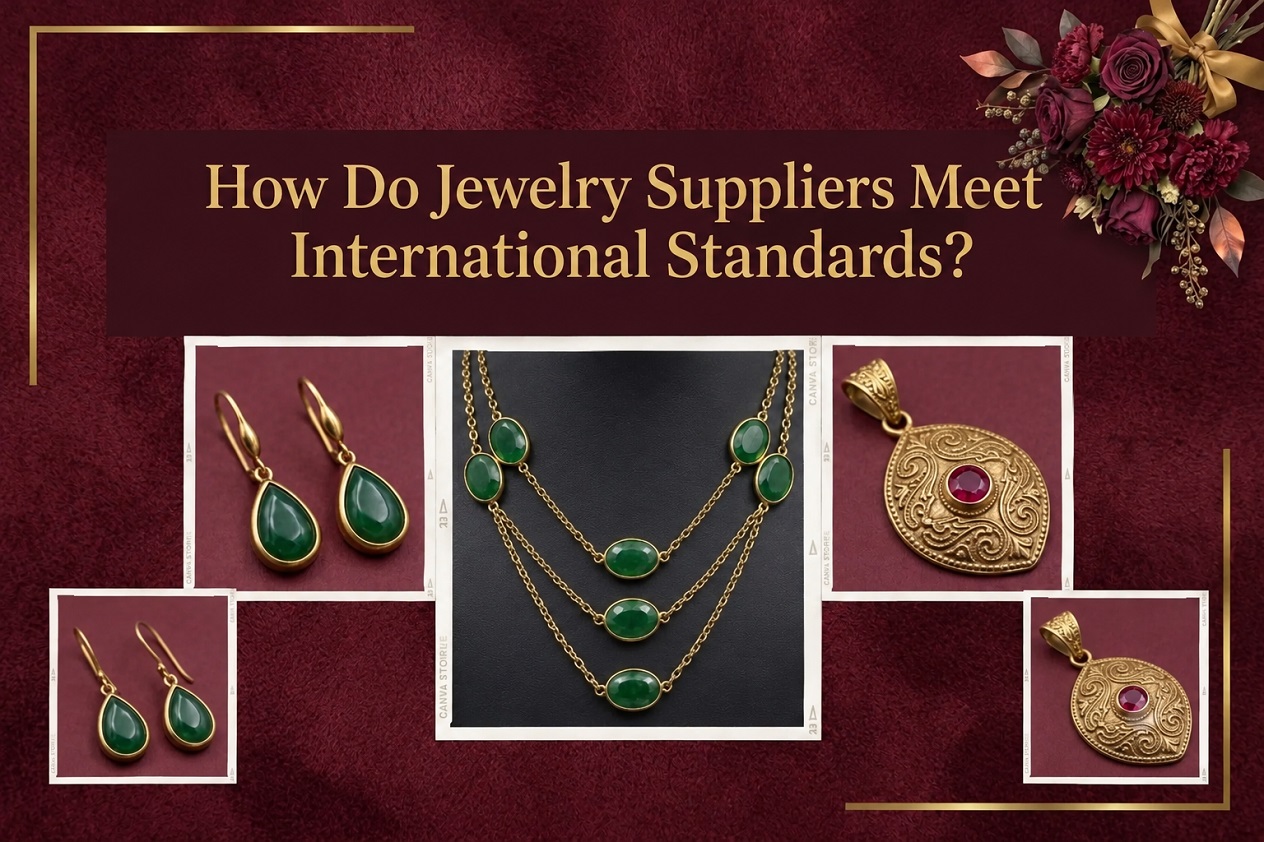
Jewelry production involves precise control over materials, processes, and documentation. International buyers expect consistent purity, accurate gemstone identification, safe materials, and reliable manufacturing practices. Suppliers who serve global markets therefore follow established technical benchmarks, independent testing protocols, and transparent record-keeping. These steps protect consumers, support fair trade, and allow products to move across borders without repeated re-testing.
Wholesale 925 Sterling Silver Gemstone Jewelry Supplier Practices for Compliance
Wholesale 925 Sterling Silver Gemstone Jewelry Supplier operations typically begin with verified raw materials. Sterling silver must contain 92.5 percent pure silver, with the remaining 7.5 percent usually copper or another approved alloy. Independent laboratories test incoming silver using X-ray fluorescence or fire assay methods to confirm composition before casting begins. Academic reviews of metallurgical standards note that consistent alloy control reduces porosity, improves workability, and limits long-term tarnish. Gemstones undergo separate verification for species, treatment status, and origin when required by the destination market. Suppliers maintain batch records so that any finished piece can be traced back to its metal and stone sources. This traceability satisfies both customs authorities and brand-level due diligence requirements.
Production facilities adopt written quality manuals that define acceptable tolerances for weight, dimension, and surface finish. Regular internal audits compare actual output against these written criteria. External certification bodies may later review the same manuals and the supporting test data.
Role of Sterling Silver Gemstone Pendants Wholesale in Quality Assurance
Sterling Silver Gemstone Pendants Wholesale channels place special emphasis on setting security and stone integrity. Pendants experience daily wear, so clasps, bails, and jump rings must meet minimum strength standards. Tensile tests and cyclic stress trials form part of routine quality checks. Gemstones are examined under magnification for chips, fractures, or unstable treatments that could fail during normal use. Color and clarity grading follows recognized gemological scales so that descriptions remain consistent across shipments. Research on consumer product safety highlights that accurate disclosure of treatments reduces returns and supports long-term buyer confidence.
Surface finishing also receives close attention. Polishing compounds and plating solutions, if used, are selected to comply with restricted-substance lists such as those under the European REACH regulation. Residual chemicals are rinsed and verified through laboratory sampling before packaging. These controls allow finished pendants to enter regulated markets without additional barriers.
Silver Bracelets Manufacturer Approaches to Global Benchmarks
Silver Bracelets Manufacturer facilities focus on structural integrity and dimensional accuracy. Bracelets must open and close smoothly while resisting permanent deformation under normal stress. Manufacturers apply standardized gauges and force meters during assembly to confirm hinge or clasp performance. Chain links or solid bands receive checks for uniform thickness and absence of sharp edges. Academic studies of wearable metal products emphasize that consistent dimensional control lowers the risk of skin irritation and mechanical failure.
Hallmarking forms another core step. Many jurisdictions require an official stamp that indicates silver fineness. Authorized assay offices apply these marks after independent testing. Manufacturers who export to multiple regions often obtain dual or multi-market hallmark recognition so that the same batch can serve different destinations. Documentation packages include assay certificates, material safety data, and packing lists that match the physical contents exactly.
Material Testing and Purity Verification
Silver purity testing occurs at multiple points. Incoming bullion or grain is assayed, intermediate castings may be spot-checked, and finished pieces are sampled according to statistical plans. X-ray fluorescence provides rapid non-destructive results suitable for high-volume lines, while fire assay remains the reference method for disputed cases. Gemstone laboratories use spectroscopic and microscopic techniques to identify natural versus synthetic stones and to detect common treatments such as heating or filling. Results are recorded against unique batch numbers. This multi-stage testing approach aligns with quality-management principles found in international standards for precious-metal articles.
Certification Systems and Third-Party Oversight
Many suppliers pursue formal management-system certification. ISO 9001 provides a framework for process control and continuous improvement. Additional schemes address social compliance or responsible mineral sourcing. Independent auditors visit facilities, review records, and interview workers. Successful audits generate certificates that buyers can verify online. These third-party statements reduce the need for every importer to conduct its own factory inspection. Technical literature on supply-chain governance shows that repeated external verification correlates with fewer non-conformities in finished goods.
Ethical Sourcing and Traceability
Responsible sourcing policies require suppliers to know the origin of both metal and gemstones. Silver may come from recycled sources or from mines that publish environmental and labor data. Colored gemstones follow chain-of-custody procedures that document cutting and trading steps. When documentation is incomplete, suppliers either reject the material or restrict it to markets that do not demand full origin disclosure. Academic work on mineral supply chains notes that transparent sourcing lowers reputational risk and supports long-term market access.
Manufacturing Process Controls
Casting, soldering, stone setting, and finishing each carry defined parameters. Temperature ranges, flux composition, and setting pressure are monitored and logged. Statistical process control charts help detect drift before defective pieces accumulate. Workers receive training on these parameters and on the handling of hazardous substances. Finished goods undergo final visual and dimensional inspection under standardized lighting. Non-conforming items are segregated and either reworked or recycled. This closed-loop approach keeps defect rates low and material loss minimal.
Export Documentation and Regulatory Alignment
International shipments require accurate commercial invoices, packing lists, certificates of origin, and, where applicable, assay reports. Some markets demand additional declarations concerning nickel release or other allergenic metals. Suppliers prepare these documents in advance so that customs clearance proceeds without delay. Regular updates track changes in destination-country rules. Trade-compliance literature stresses that proactive documentation reduces demurrage costs and protects delivery schedules.
Conclusion
Meeting international standards requires coordinated attention to material purity, process control, independent testing, ethical sourcing, and complete documentation. Jewelry suppliers who integrate these elements into daily operations produce consistent, traceable products that satisfy both regulatory and commercial expectations. The same systems also support continuous improvement, allowing manufacturers to adapt as standards evolve. In this way, technical discipline and transparent practices together enable reliable cross-border trade in sterling silver and gemstone jewelry.
Frequently Asked Questions (FAQs)
Que. What purity level defines 925 sterling silver?
Ans. Sterling silver must contain 92.5 percent pure silver by weight. The remaining portion consists of approved alloying elements, most commonly copper. Independent assay confirms this ratio before hallmarking.
Que. Why do suppliers use both X-ray fluorescence and fire assay?
Ans. X-ray fluorescence offers fast, non-destructive screening suitable for high volumes. Fire assay provides the definitive reference result when higher precision or legal certification is required.
Que. How are gemstones verified for wholesale shipments?
Ans. Gemological laboratories identify species, detect treatments, and grade color and clarity using standardized methods. Results are linked to batch numbers so each pendant or bracelet can be traced.
Que. What role does hallmarking play in international trade?
Ans. An official hallmark certifies silver fineness after independent testing. Many export markets accept recognized hallmarks, reducing the need for repeated assays at the destination.
Que. How do manufacturers control restricted substances?
Ans. Incoming materials and finishing chemicals are screened against lists such as REACH. Residual testing after polishing or plating confirms that finished pieces meet release limits for nickel and other regulated elements.